Description
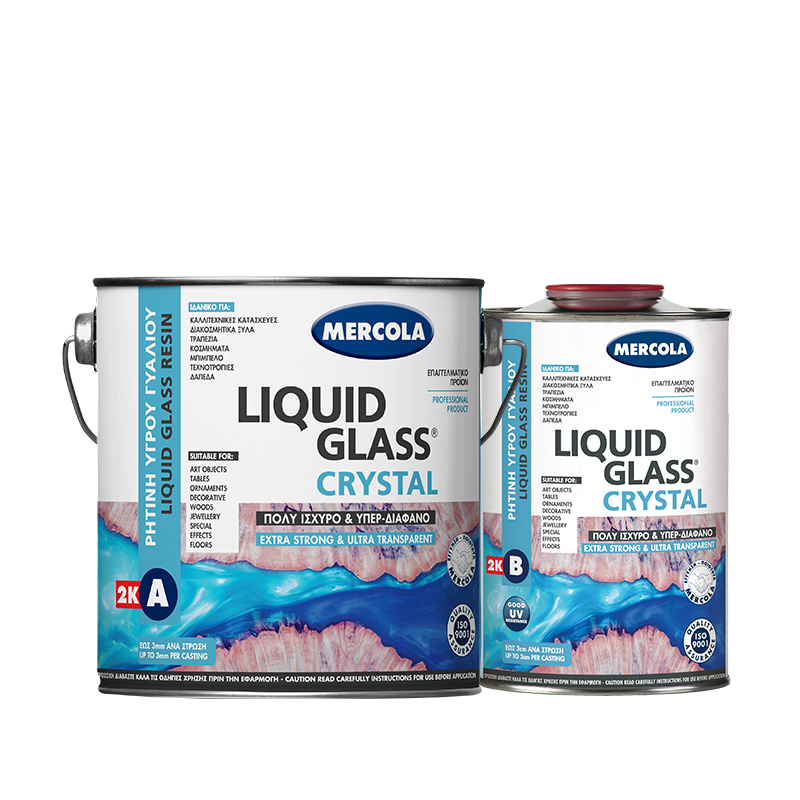
LIQUID GLASS CRYSTAL is a tough, super transparent two-component epoxy resin, which offers great resistance to temperature, humidity and solvents after curing. It is ideal for impregnation, molding and clear casting dissimilar materials and ornaments without shrinking. It is ideal for making special decorative – artistic applications with sculptured objects, by filling voids and pores and forming a final glass-like surface. Use LIQUID GLASS CRYSTAL to create wonderful artistic constructions for decoration and use. Ideal for castings up to 3cm thick per layer.
ADVANTAGES
- Fast curing
- Transparent - clear
- Low viscosity for easy penetration and less foaming
- Excellent adhesion and bonding strength
- Excellent mechanical properties
- Excellent moisture, temperature and chemical resistance
- Mild reaction, allowing better defoaming and thicker castings.
- Reduced effect of low temperatures and humidity while curing
- Castings from 5mm to 30mm depending on the total mass.
- Can be colored with LIQUID GLASS COLOUR
APPLICATIONS
- Thousands of applications can be made with any idea and most materials. Tabletops such as the famous river tables, bowls, serving platters, stools, 3-D displays with leaves and flowers dried or pressed, shells, insects, pebble stones, mineral stones, souvenirs, jewelry, photographs, coins, seeds, peas, beans, pasta, spices, decorative wood constructions and much more.
- Transparent floor coatings with decorative elements such as pebbles, coins, and many other items.
- LIQUID GLASS Is ideal for protection and decoration of many surfaces such as wood, metal, stone, ceramics, porcelain, cardboard, etc.
- Use your imagination, internet and YouTube for ideas and application methods.
Specifications
 |  |  |  |
Coverage:
~1,1kg/m2/mm | Thinning:
No | Initial bonding:
5 - 7 hours | Final bonding:
4 - 7 days |
 |  |  | |
| Interior use | Application temperature:
+15oC to +30oC | Cleaning:
With DIL X 100 solvent | |
Instructions for use
You must pay close attention to the quantity and the way of mixing the 2 components. Danger of high temperatures due to exothermic reaction.
- Temperature and humidity requirements: ambient temperature 20oC – 28oC and humidity up to 50-55% (use of a dehumidifier is recommended).
- All surfaces must be dry and clean from dust and grease.
- Make sure that the materials used for stirring and dosing containers are clean and moisture free.
- Using a spatula, mix quantities by weight at the ratio written on the package.
- It is advisable to use a precision scale.
- Stir well for 3-5 minutes the 2 components with a spatula or a low-speed electric drill, very slowly to avoid foaming in the mixture.
- Mix small quantities each time since the mixture will start hardening rapidly. The larger the quantity mixed and the higher the temperature, the faster the rate of acceleration of the curing due to the exothermic reaction. Extreme care is required at temperatures above 28oC and below 15oC. Recommended working time 5 - 10 minutes up to 15 - 30 minutes at lower temperatures. Always monitor the temperature of the mix.
- If you apply the material in layers make sure that each layer is applied after curing of the previous layer to avoid line creation and reduced transparency.
- For large epoxy resin molds, you will want to use sturdy, flat materials such as high-density polyethylene or melamine combined with self-adhesive tapes and nylon sheets. For smaller objects, you will want to use silicone or small plastic containers to achieve the correct shape.
- Apply the material into the mould making sure that there is no leak. Use silicone to seal all joints.
- During curing, dust, high temperatures, air flows (e.g air condition) and very importantly high humidity should be avoided.
- If you are using LIQUID GLASS as a varnish spread material with a spatula or brush.
- Any air bubbles can be removed using a needle, a hair drier, a heat gun, a butane torch, or barbecue jet type lighter. Please use caution when using a flame! Do not use heat source on one spot for extended time. It is recommended to have a fire extinguisher nearby.
- Initial curing time 5 - 7 hours, and final curing is achieved in 4 - 7 days depending on layer thickness and room temperature.
- Following full curing one can machine – sand the cured object using different grades of sandpaper from coarse to fine which will lead to a glass like finish for the sanded areas.
CAUTION
- Humidity and wood chemicals affect the chemical process resulting in bubbles. Special care should be paid to applications with wood where it is difficult to measure humidity. In such applications the wooden surface must be primed with LIQUID GLASS in one or two thin layers. If any bubbles appear on the surface, sand and prime again the surface.
- It is recommended not to mix large quantities of material. Cast the material immediately after mixing and monitor temperature. If overheating of the material is observed - severe thickening, do not use. High temperature accelerates exothermic reaction and traps bubbles while mixing the material.
- If casting over 15mm, continuous temperature monitoring and / or casting in successive layers is recommended.
- Due to the nature of the material, direct and prolonged exposure of the polymerized LIQUID GLASS to ultraviolet (UV) radiation may cause the surface to yellow. This effect is significantly mitigated by applying LIQUID GLASS UV PROTECT VARNISH, which provides protection against yellowing caused by solar UV radiation, as well as against scratches.
- Lightweight objects must be fastened (secured to their intended position) to avoid floating or moving until final curing.
- In case of severe overheating with possible smoke release, spray the surface with water to lower the temperature.
- Close lids firmly after use and do not change lids between containers.
- All tests should be carried out before final application.
- Suitable for use by professionals or experienced users.
- Please contact our technical support for any technical assistance.
COLOURING LIQUID GLASS
You can color LIQUID GLASS with LIQUID GLASS COLOUR colorants of your choice: LIQUID GLASS COLOUR TRANSPARENT to preserve transparency in your LIQUID GLASS creation, LIQUID GLASS ULTRA TINT for an opaque colored result or choose LIQUID GLASS COLOUR EFFECT to add a metallic or pearl effect. It is certain that whatever your choice is, LIQUID GLASS COLOUR colorants will offer an exceptional color effect to your creations. It takes a lot of care to achieve the desired result. The colorants are very concentrated. 1-3 drops may be enough for coloring 50gr of final product. Instruction for use: Add just a few drops of colorant in component A (resin). Stir well to blend using a spatula or a tongue depressor. Special attention must be given to the bottom and sides of the container. Add part B (hardener) and mix well. Caution: Too much colorant (>2% of total mixture weight) will inhibit the cure of the resin. Colorants may be used to color an entire casting or can be used in a top, middle, or bottom layer to create depth or other effects. Keep in mind that colored resin in your mixing container will look much darker than when poured into a thinner area. It is recommended that the final tint and hardening of the mixture is tested before the application.
CLEANING
Tools and adhesive residues should be cleaned right after use with nitro solvent. After the material has hardened it can be removed using MERCOLA STRIPP & CLEAN paint stripper.