Description
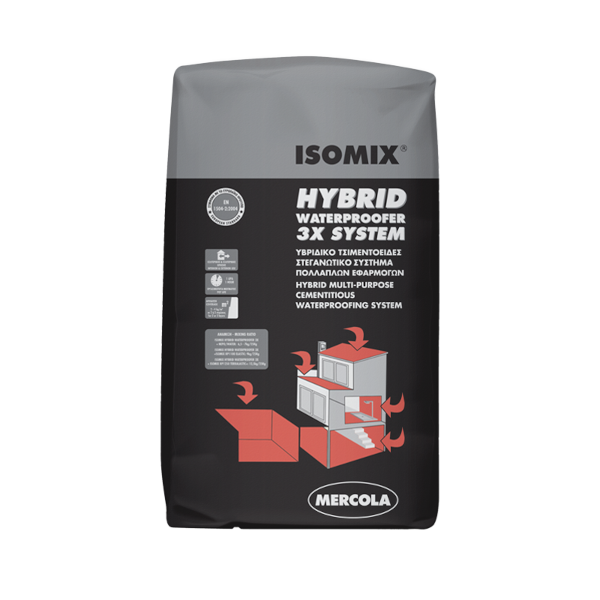
ISOMIX HYBRID WATERPROOFER 3X is an innovative hybrid cementitious waterproofing system for multiple applications. By adding clean water, a basic one-component waterproofing system is produced, providing economical and effective waterproofing for structural applications with standard adhesion and flexibility–elasticity requirements. For projects with higher performance demands, it can be mixed with the acrylic emulsion ISOMIX RP1100 or the polyurethane-modified acrylic emulsion ISOMIX RP1250, producing a flexible, fiber-reinforced two-component waterproofing system with high mechanical strength for demanding waterproofing applications. It exhibits increased resistance to both positive and negative hydrostatic pressure and is capable of bridging microcracks. The product is classified as a concrete surface protection system according to EN 1504-2.
ADVANTAGES
- Fast curing
- High mechanical strength
- Strong adhesion
- High resistance to positive hydrostatic pressure, providing waterproofing even under pressure up to 5 atm (EN 12390-8)
- Capable of withstanding negative hydrostatic pressure
- Vapor permeable
- Ageing resistant
- Excellent adhesion on damp surfaces without prior priming
- Easy and economical application
- Suitable for interior and exterior use
- Protects concrete against carbonation
APPLICATIONS
- Waterproofing and sealing of roofs, balconies and other wet areas such as bathrooms and kitchens that will be covered with tiles or other final coatings.
- Waterproofing and sealing of basements, externally or internally, even in cases of negative hydrostatic pressure.
- Waterproofing of surfaces made of concrete, plaster, brick, cement blocks, aerated concrete, mosaic, gypsum board and other common building substrates.
- In cases where hairline cracks are present or there is a possibility of their formation, the use of the flexible systems “ISOMIX HYBRID ELASTIC 2K” or “ISOMIX HYBRID TERRALASTIC 2K” is recommended.
Specifications
 |
 |
 |
 |
|
Coverage:
2,0 – 4,0 kg/m2
|
Thinning:
No
|
Application:
by brush
|
Application:
by brush
|
 |
 |
 |
 |
|
Application:
by trowel
|
Application:
by roller
|
Application:
by spray gun
|
Touch dry:
4 - 8 hours
|
 |
 |
 |
 |
|
Hard dry:
7 days
|
Interior use
|
Exterior use
|
Application temperature:
+5oC to +35oC
|
 |
|
|
|
|
Cleaning:
With water
|
Instructions for use
Application preparation
- Surface Cleaning: Ensure surfaces are free from dust, salts, oils, and loose residues.
- Sealing Leaks: Cracks, capillaries, and leakage points must be sealed using the same material if there is no water flow or with ultra-fast setting cement if water flow is present.
- Filling Holes & Cavities: Holes or voids in concrete should be filled and leveled with ISOMIX RAPID CEMENT or ISOMIX MECHANIC after removing loose materials and moistening the surface.
- Exposed Reinforcement: Any exposed reinforcement should be cut to a depth of approximately 20-30 mm into the concrete, and the holes should be filled using the above method.
- Construction Joints: Joints should be opened along their entire length, approximately 35 mm deep in a V-shape, and filled with ISOMIX RAPID CEMENT or ISOMIX MECHANIC.
- Basement Waterproofing (Old Constructions): In the case of underground waterproofing for existing buildings, the existing plaster must be removed at least 50 cm above the underground water level, followed by the application of ISOMIX HYBRID WATERPROOFER 3X.
- Corners & Junctions: Floor-to-wall junctions and other corners should be rounded using ISOMIX RAPID CEMENT or cement mortar reinforced with ISOMIX RESIN SBR 400, forming a triangular shape.
- Surface Leveling & Slope Creation: Where surface leveling or slope formation is required, the use of ISOMIX SELF LEVEL 1-30 self-leveling mortar is recommended.
- Pre-Wetting the Surface: Before application, homogeneously moisten the dry, porous surface using clean water. Avoid excessive water accumulation.
Application (mixing with water)
- Mixing the Components: in a clean container, first add 6,5-7Lt of water, then gradually add 25kg of ISOMIX HYBRID WATERPROOFER 3X mortar under continuous stirring. Use a low-speed electric mixer to prevent air bubble formation. Mix until a uniform, thick, and spreadable mortar is obtained, capable of being applied in thin layers without running.
- Application Method: apply the mixture using a trowel, spatula, brush, or roller. Each layer should be maximum 1mm thick, ensuring full coverage of the surface.
- Reinforcement (For Enhanced Strength): While the first layer is still wet, embed 65-90 gr/m2 or ή 150-160gr/m2 fiberglass mesh into it. In this case, three layers are required.
- Second Coat: Once the first coat has dried (4-8 hours), apply the second coat crosswise, fully covering the embedded mesh.
- Third Coat (For High-Performance Applications): For more demanding structures, a third coat is recommended. The total thickness should not exceed 2,5mm.
- Workability: The mixture remains workable for up to 1 hour, depending on the temperature.
- Moisten the surface before each coat, ensuring it is damp but without standing water.
- Waiting Time Before Overcoating: Before covering the waterproofing layer with another cementitious material, wait 2 – 7 days (longer in lower temperatures, shorter in higher temperatures).
Cleaning
Clean the tools immediately after use with soap and water. The polymerized - dried material can only be removed by mechanical means.
Remarks
- Do not apply more than 1,5 kg/m2 per layer.
- Protect the surface from rain or frost for at least the next 48 hours.
- Do not finish the surface with a straightedge or float after it has dried.
- Do not add water or aggregates to the mixture.
- Embed fiberglass mesh tape or polyester fabric at wall–floor junctions and along joints to reinforce the waterproofing layer.
- Do not expose the product to intense sunlight before use.
- Do not apply at temperatures below 5oC or above 35oC.
- In very hot or dry conditions, if the application cannot be postponed, lightly spray the surface with water during the first two days to prevent cracking.
- The substrate must be designed to statically withstand hydrostatic pressure.
- If tiles are to be installed after applying the waterproofing system, select a resin-modified adhesive of at least category C2TE.
- Do not apply on substrates that have not fully cured.
- In cases of backfilling, install a protection membrane (e.g. a dimpled drainage membrane) over the water proofing layer.